Teak or Sheesham? An Honest Answer for Punjab Homes
Walk into any furniture showroom in the Tricity and you will be told the wood in front of you is the best wood. We are going to do something less convenient: explain where sheesham genuinely beats teak, and then explain why we still build every piece in our workshop from teak anyway.
If you are furnishing a home in Mohali, Chandigarh or Panchkula, this is a decision worth ten minutes of your attention. You will live with it for thirty years.
Start With the Number That Does Not Favour Us
On the Janka scale, which measures how much force a wood resists before it dents, sheesham comes in at roughly 1,660 lbf. Teak sits at about 1,070 lbf.
Read that again, because most teak sellers will not tell you. Sheesham is meaningfully harder than teak. Drop a heavy vase on a sheesham tabletop and a teak one, and the teak is likelier to carry the dent.
Sheesham has two more things going for it. It is native to Punjab, Uttar Pradesh and Rajasthan, so it travels a short distance to reach a workshop here, which shows in the price. And it carries natural oils of its own, giving it real resistance to insects and moisture. Sheesham is not a compromise wood. Good sheesham furniture, properly made, is good furniture.
So why do we not use it?
Hardness Is Not the Property That Fails Furniture
In our experience, furniture in this part of India rarely fails because someone dented it. It fails because it moved.
Consider what a piece of furniture endures in a Chandigarh year. May and June are punishingly dry, with the air pulling moisture out of everything in the room. Then the monsoon arrives and the humidity climbs for weeks. Then winter turns cool and dry again. Wood is not inert through any of this. It absorbs moisture and swells, releases it and shrinks, every year, for as long as it exists.
That annual breathing is what opens joints, splits panels, sticks drawers in July that slid freely in April, and cracks tabletops along the grain. And it is measured by a property called dimensional stability.
Teak's volumetric shrinkage is around 7.2 percent. Sheesham's is around 8.4 percent.
The gap looks small written down. Across a wide dining table, a bed frame or a wardrobe door, over two decades of Punjab summers and monsoons, it is the difference between a joint that holds and a joint that works itself loose. Teak's tight grain and its natural silica content are what keep it still.
The Oils, and Why They Matter More Here Than in Europe
Teak's reputation was not built in living rooms. It was built on ship decks, where wood sits in salt water for decades. That reputation comes from the oils and silica the tree produces naturally, which resist water, fungal decay and termites without a single chemical treatment.
Termites are not a theoretical concern in Punjab. They are a normal household problem. Teak's resistance is built into the material itself, so it does not wear off, cannot be skipped by a supplier trying to save money, and does not need reapplying in year eight.
Sheesham resists termites too, but with an important condition attached, which brings us to the part of this comparison that actually decides most outcomes.
The Real Variable Is Not the Species. It Is the Seasoning.
Sheesham's pale sapwood, the outer band of the log, is not durable and has to be cut away. The remaining heartwood must then be seasoned carefully, dried down to roughly 5 to 6 percent moisture for thinner sections, before anything is built from it. Sun-drying in the open takes about six months. A commercial kiln does it in one to two weeks.
Skip that, and the wood does its drying inside your bedroom instead. That is the warped wardrobe door, the cracked headboard, the termites that found moisture the seasoning should have removed. Most of the sheesham furniture that disappoints people was not badly designed. It was rushed.
Teak is more forgiving of an impatient workshop, and it is expensive enough that nobody buys it to cut corners. But we want to be straight with you: a well-seasoned sheesham piece from a careful maker will outlast a badly-seasoned teak one. Species is the headline. Seasoning is the story.
This is also the single most useful question you can ask any showroom in the Tricity, ours included: how long was this wood seasoned, and how? A seller who cannot answer is telling you something.
What About Mango, Acacia and "Engineered Wood"?
Two of the largest furniture retailers serving Mohali build extensively in sheesham, mango and acacia. Mango and acacia are considerably softer and less stable than either wood discussed above, and they are priced accordingly.
Engineered wood, sold as MDF, particle board or HDF, deserves separate mention because it is what most furniture under a certain price is actually made from, including pieces described as "wooden". It is wood fibre and adhesive pressed into sheets, then wrapped in a printed veneer. It is dimensionally stable, genuinely, and it is inexpensive. But it cannot be carved, it cannot be repaired, it cannot be refinished, and it swells irreversibly once water reaches the core. It is furniture with a fixed expiry date.
So: Which Should You Buy?
Honestly, it depends on what you are buying and what you intend it to become.
- Choose sheesham if you want solid hardwood at a lower price, from a maker who will tell you exactly how the wood was seasoned. It is dense, it is beautiful, it is local, and for many rooms it is the sensible answer.
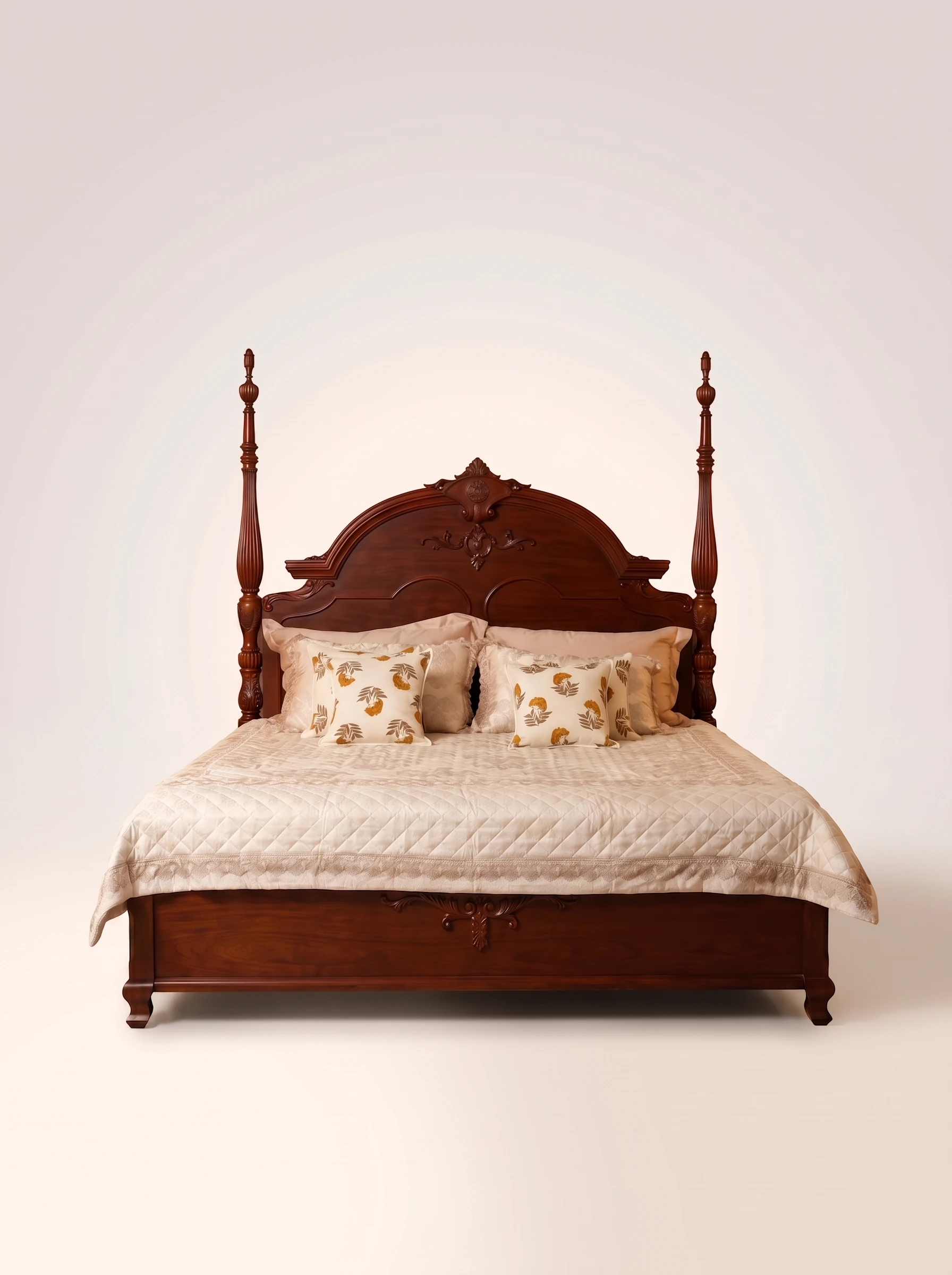
- Choose teak if the piece needs to stay dimensionally true for decades: a large dining table, a poster bed, a wardrobe with doors that must keep closing properly. Or if you intend to hand the piece down rather than replace it.
- Avoid engineered wood for anything you want to still own in ten years.
We build only in teak because we make carved, heirloom furniture, and carving rewards a wood that will not move underneath it. A carved crest that shifts a millimetre is a carved crest that has cracked. That is our specific reason. It is not a claim that every other wood is bad.
Come and Judge It Yourself
Photographs cannot show you grain, weight or the way a drawer runs. Our showroom is at Plot 1540, JLPL Industrial Area, Sector 82, Mohali, and we are open daily from 10am to 8:30pm. Bring your room dimensions. Open the drawers. Ask us about the seasoning.
You can browse the full collection first, or book a showroom visit so someone is free to walk you through it properly. If you would rather just ask a question, call us on +91 70189 86215.